Regional Comparison
Madeira vs Açores: where should you buy?
Madeira and the Açores are Portugal’s two Atlantic archipelagos, and the choice between them is the one that comes after you have already decided against the mainland. Madeira is a subtropical island centred on Funchal, with year-round tourism, dense direct flight links and one of the country’s most internationally driven housing markets; the Açores are nine inhabited islands much further out in the ocean, green and volcanic, with a smaller and more local market spread across island economies that differ sharply from one another. This guide sets their latest official transacted and rental medians side by side — each with its source and reference period, against the national baseline — so the which-archipelago choice rests on real figures rather than on reputation.
Last updated · First published
Madeira vs Açores, by the numbers
Each metric below is the latest official median for both regions, shown side by side against the national figure so you can see how they compare. Transacted (sold) prices are drawn from INE’s house-price statistics; every cell shows its reference period and source.
| Metric | Madeira | Açores | Portugal (national) |
|---|---|---|---|
| Median sold priceSold · INE | €2,578/m² 1st Quarter 2026 | €1,494/m² 1st Quarter 2026 | €2,168/m² 1st Quarter 2026 |
| Median new-lease rentRent · INE | €12.78/m² 2nd Quarter 2026 | €7/m² 2nd Quarter 2026 | Data pending — published only when the warehouse can source it with provenance. |
| Region-level only — INE does not publish a concelho-level rent series, and no national single-figure baseline is shown for new-lease rent. | |||
Asking vs sold
Every figure above is a transacted (sold) median from INE. We publish an asking-price figure only from a licensed source, never scraped listings, and always label it separately from the sold median so the two are never conflated — for both regions, asking-price data is pending.
Madeira vs Açores: how the two markets differ
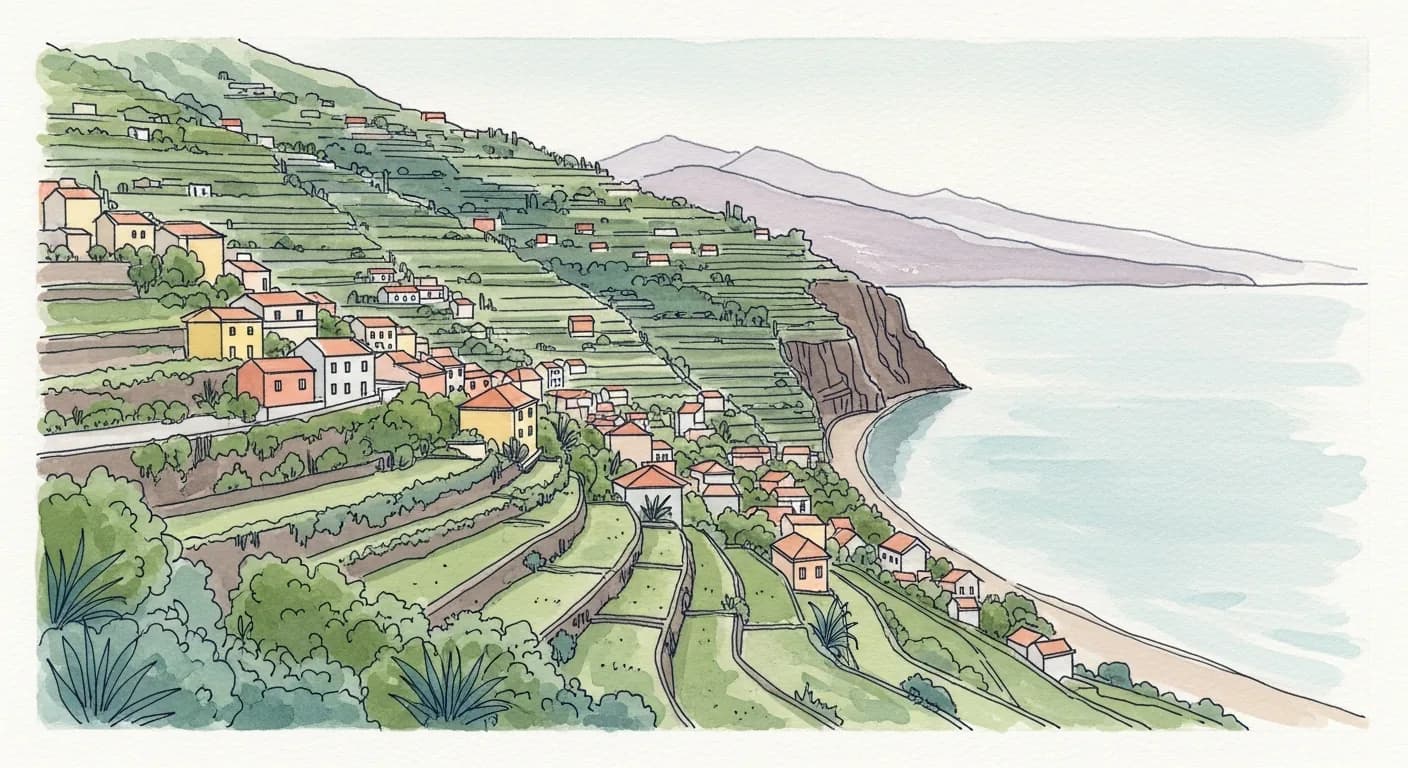
These are Portugal’s two autonomous regions, both Atlantic archipelagos, and they are far less alike than the shared label suggests. Madeira is a subtropical island and its small neighbour Porto Santo, lying south-west of the mainland: terraced levada country climbing steeply from the sea, a mild and stable year-round climate, and a capital, Funchal, that concentrates most of the region’s population, its cruise and hotel economy and its housing demand. Direct flights arrive year-round from across Europe, and the island has built one of the country’s most internationally exposed markets — retirees, remote workers and second-home buyers alongside local demand. The Açores are nine inhabited islands much further out in the mid-Atlantic, in three clusters: São Miguel and Santa Maria in the east, Terceira, Graciosa, São Jorge, Pico and Faial in the centre, and Flores and Corvo in the west. The landscape is volcanic and green — crater lakes, pasture divided by hydrangea hedges, whitewashed houses with dark basalt trim — and the economy rests on agriculture and dairy, fishing, public administration and a tourism industry that grew quickly once low-cost direct flights reached São Miguel. Both regions legislate for themselves in areas that matter to buyers.
An honest read has to be clear about what each headline measures, and on this pair the geography is the cleanest of any comparison we publish. Portugal’s statistics office publishes transacted prices for statistical sub-regions and municipalities rather than for districts, and most regional headlines therefore need a caveat — a sub-region reaching across a district line, or a district with municipalities filed elsewhere. Neither side here owes one: each autonomous region is a published statistical region in its own right and maps exactly onto its own set of municipalities, eleven in Madeira and nineteen in the Açores, with none borrowed from anywhere else and none left out. So both figures above are exactly what their names say.
The caveat that does matter runs the other way, and it is much heavier on one side than the other. Neither archipelago is a single market. Madeira’s median is pulled by Funchal and the sunnier south coast, away from the quieter north coast, the interior and Porto Santo. The Açorean median averages nine islands whose air links, economies and housing stock differ sharply: São Miguel and Terceira carry most of the transactions, while the smaller central and western islands trade thinly enough that a regional average describes none of them well. The full regional guides below break every municipality out with its own source — that is where the internal spread becomes visible. We never synthesise a single island figure.
Short-term rental rules, compared
Short-term letting (Alojamento Local, AL) matters on both sides, but it carries a different weight. In Madeira it is central to the investment case: tourism runs year-round rather than in a summer season, and Funchal and the south coast sustain occupancy through the winter. In the Açores it is a real but smaller and more seasonal business, concentrated on São Miguel and Terceira and on the nature, whale-watching and hiking trade, and much thinner on the islands with fewer direct flights. Both regions are governed by the national AL regime (Decreto-Lei 128/2014, as amended) and by rules specific to their own autonomous region, which legislates in this area — so registration and operating requirements on either archipelago can differ from the mainland and are administered by regional bodies as well as by the câmara municipal. Contention-style limits and local status vary by concelho and change over time.
This is general information, not legal advice — confirm the current AL status, the regional requirements and any local limits for a specific address with the relevant câmara municipal and the regional authorities before assuming a property can be operated as a short-term rental.
So which should you buy in?
There is no single winner, and the trade is unusually clear-cut. Madeira offers the deeper and more liquid of the two island markets, a mild year-round climate, dense direct flight links, an established international community and the strongest rental fundamentals of any region outside the capital — at the cost of the higher entry price of the two archipelagos, a market where international demand competes directly with local buyers, and steep terrain that makes level building land scarce and expensive. The Açores offer materially lower transacted prices and rents, far more space and building for the money, dramatic volcanic landscape and a slower, more local way of life — at the cost of a much thinner resale market, fewer buyers to sell on to, weather that is cooler and considerably wetter than Madeira’s, and island-by-island differences in air links and services that make the choice of which island as consequential as the choice of region.
Both sides share one thing the mainland pairings do not: this is a decision to live on an island, with the freight costs, flight dependency and hospital-access questions that follow, and neither archipelago’s regional median describes any single island particularly well. Read the two full regional guides below for the AL, IMI and municipality-level detail on each side — all eleven Madeira municipalities and all nineteen Açorean ones, each with its own source — then map the resolved figures on this page to your specific purchase with an advisor.
Common questions about Madeira vs Açores
- Madeira vs Açores: which is cheaper to buy property in per square metre?
- In Região Autónoma da Madeira, the median transacted (sold) price is about €2,578 per square metre (1st Quarter 2026); in Região Autónoma dos Açores it is about €1,494 per square metre (1st Quarter 2026). Both are transacted (sold) medians — what buyers actually paid, not asking prices — so they are compared like for like. For comparison, the national median sold price is about €2,168 per square metre (1st Quarter 2026). Source: Instituto Nacional de Estatística (INE), Portugal, CC BY 4.0.
Read the full regional guides
Go deeper on each region
Plan your purchase
Related comparisons
Every figure on this page is drawn from the public data registry with full provenance — official sources, reference periods and licences. We publish a number only when the warehouse can source it.
Recent legal changes
Still deciding between Madeira and Açores?
Map the numbers on this page to your specific purchase. Speak with an advisor about costs, timeline and paperwork in either region.
Book a free consultation